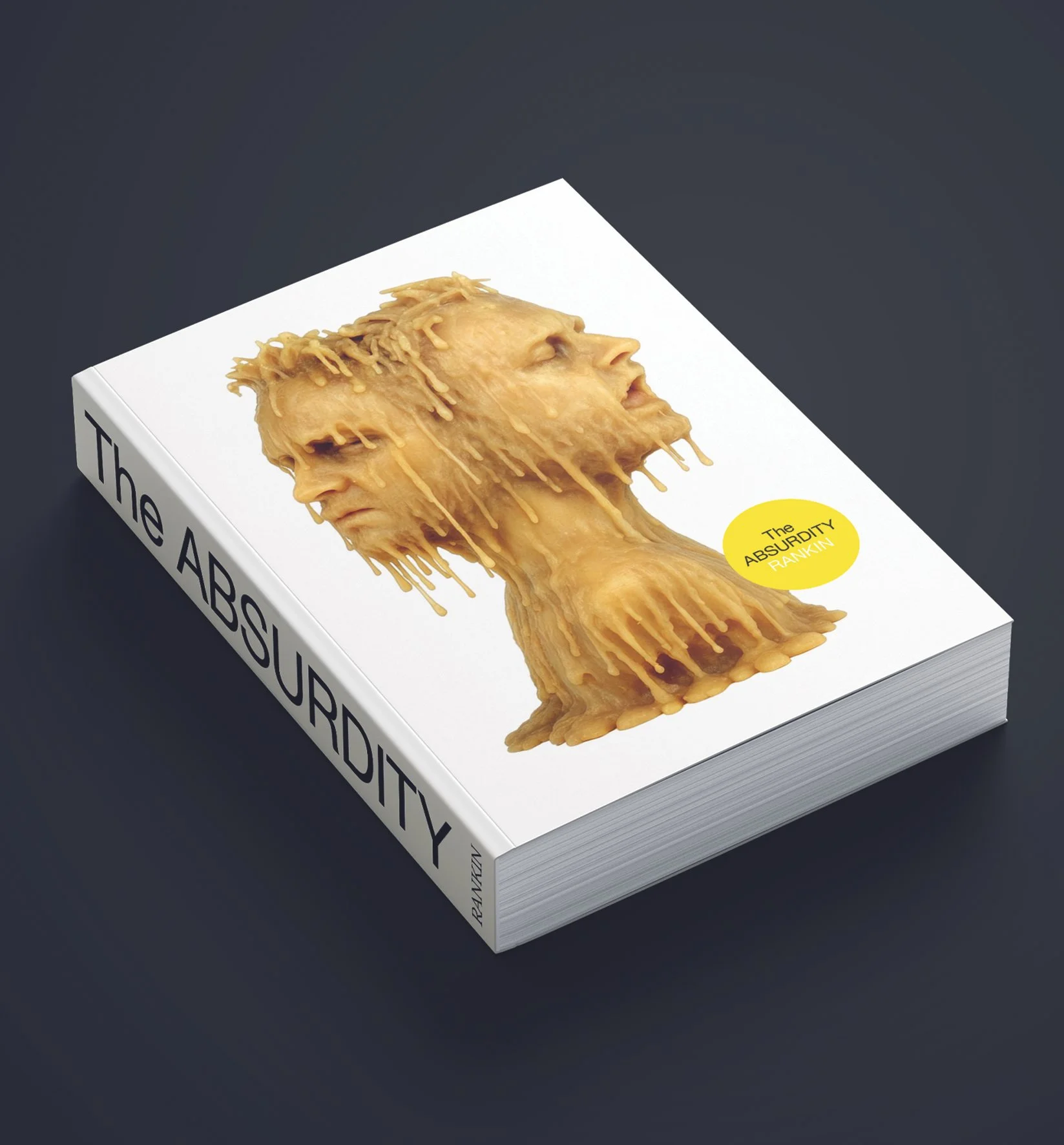
INTRODUCING: THE ABSURDITY
EXCERPT from hunger 38 (faik mini issue)
ORIGINAL PHOTOGRAPHY BY RANKIN
AI GENERATOR RANKIN
WRITTEN BY AI
There was a time when photographers worried about lighting ratios, difficult subjects, and whether someone had blinked. Now they worry about whether the entire concept of reality has quietly resigned.
In The Absurdity, Rankin does something unfashionable. Instead of declaring AI either the end of civilization or the dawn of frictionless genius, he walks straight into it and refuses to look away. He uses the machine, interrogates it, feeds it his life’s work, and then asks the only question that actually matters: if anything can be made, what is worth keeping?
This isn’t a Luddite lament. It’s worse than that. It’s a clear-eyed account of what it feels like to watch your own medium dissolve in real time. Photography, once a trace of something that stood before you, becomes raw material for infinite remix. Evidence turns into aesthetic suggestion. Truth becomes performance. And somewhere in the background, we’re all nodding along as if human obsolescence is a minor scheduling conflict.
The genius—and irritation—of this book is that it refuses purity. Rankin is complicit. He’s addicted. He’s exhilarated. He collaborates with the very systems he suspects may hollow out authorship altogether. There’s no clean position left. That’s the point. The tension is structural. Use the tools and you train them. Refuse them and you become irrelevant. Welcome to modernity, but on fast-forward.
Then, in an act that feels either heroic or faintly deranged, he proposes bronze as resistance. Bronze. As in molten metal, two years of labor, the opposite of a scroll. He takes disposable digital fantasies and imagines them cast in the material once reserved for emperors and gods. It’s both satire and sincerity. A selfie as monument. A dog photo with the gravitas of Bernini. The joke lands because it’s also a diagnosis.
What emerges is not a manifesto, and mercifully not a TED Talk. It’s a document of what it feels like to live inside collapse without pretending it’s progress: the collapse of authorship, of stable truth, of myth that actually binds rather than fragments, of intimacy replaced by frictionless simulation. Rankin isn’t offering solutions. He’s describing the water while we’re all drowning in it.
And here’s the uncomfortable part: the machine can replicate his lighting, his aesthetic, even something that looks suspiciously like his vision. What it cannot replicate is the encounter—the moment he stood in front of someone and chose to witness them. The relationship that gives an image weight. The simple, stubborn fact of having been there.
In a culture drunk on infinite generation, that begins to look like rebellion.
The Absurdity is about living in contradiction without anesthetic. It’s about making work while the floor gives way. It’s about accepting that meaning may be negotiable, but presence is not. And in an age where everything can be generated, it makes a bracingly unfashionable claim: the last human act might simply be choosing what to keep.
Unsettling. Necessary. Slightly alarming. Exactly the sort of book you’d expect from someone who decided not to blink.